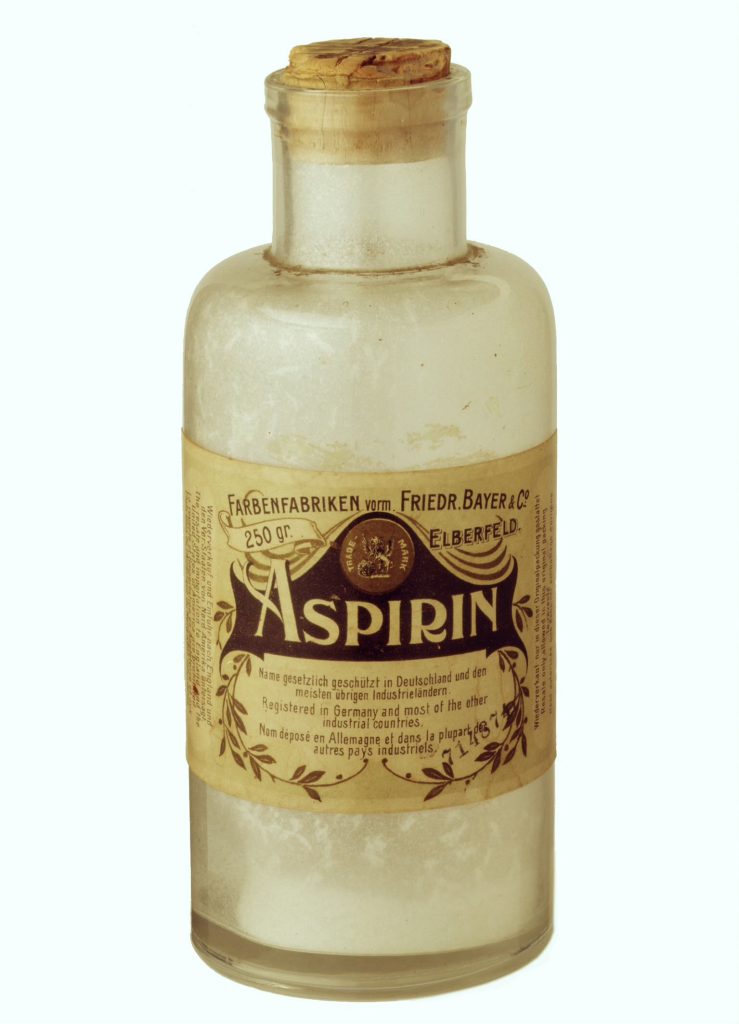
Aspirin has been around for a very, very, long time. The ancient Egyptians and Greeks used extracts of the willow bark tree – which contains salicylic acid, aspirin’s active ingredient – as a remedy for pain and fever. Then in the 1800s, chemists figured out how to manufacture a concentrated version of this substance and market it as the pain reliever we call aspirin. Right up through the 1950s, aspirin remained the most popular medication for pain, fever reduction, and inflammation. But with the advent of better medications like acetaminophen (Tylenol) and ibuprofen (Advil), aspirin’s popularity began to wane. Thus the first act in aspirin’s long story came to a close.
Aspirin might have remained an antiquated pain reliever with low sales had it not been for the discovery, starting in the 1960s, that it can also prevent the clots that cause heart attacks and strokes. Today, aspirin is widely prescribed for those who have already suffered, or are thought to be at extremely high risk of suffering, one of these events. And, it wasn’t that long ago when millions of Americans who were otherwise healthy and low risk for cardiovascular disease also took a daily aspirin to help ward off future cardiovascular disease. But there has been pushback against this practice in recent years. As with any medication, aspirin can have serious side effects – stomach ulcers, brain bleeding, and kidney damage being among them – and beginning about a decade ago, the medical establishment began to be more targeted in our use of aspirin, reserving it for the highest risk folks, but not the average patient in whom the benefits may not outweigh the risks. Hence, aspirin has settled out in the past few years as a widely taken and important medication in the world of cardiovascular prevention, but down from its peak use in the 1990s and early 2000s. Thus the second act in Aspirin’s story seems to have come to a close.
But this ancient medicine keeps on giving and – it appears – aspirin may be on the dawn of a third act. Accumulating evidence over the past few decades has begun to suggest that regular aspirin use might help to prevent gastrointestinal cancers such as colon, esophagus, stomach, and pancreatic cancer. Consider the following:
A 2024 review by doctors in the UK found that diabetic patients taking regular aspirin had a 40% reduced risk for developing pancreatic cancer as compared to diabetics who did not take aspirin.
Another database review in the UK found that, over an 18 year period of follow up, regular consumers of aspirin had approximately half the rate of gastric (aka stomach) and esophageal cancers as the general population.
While all of the above is promising, these types of epidemiological studies are prone to confounding and should always be taken with a grain of salt. For example, it may be that people who take aspirin regularly do so because they are at very high risk for heart disease, and the reduced rate of GI cancers in this group is due to dying of heart attacks and strokes before they can develop cancer; or to other medications that they take to protect their heart; or because they are following specific dietary guidance for their heart problems.
However, now higher quality evidence is starting to emerge that aspirin may truly play a role in fighting cancer.
A team in Britain recently published results of several randomized control trials in patients with a rare genetic condition called Lynch syndrome that predisposes to colon cancer (as many as 75% of patients with Lynch syndrome will develop Colon cancer during their lifetime). They have found that compared to Lynch syndrome patients taking placebo, those taking a daily aspirin had half the number of colon tumors over a several year period of follow up. And another recent study out of the UK showed that, among some patients who have already been diagnosed with colon cancer, taking a daily aspirin seems to reduce the risk for recurrence.
Much research remains to be done, and many questions are not yet answered, but it is possible that aspirin – the great pain reliever of the 1800s, and cardiovascular medication of the 1900s – will soon be resurrected again as a cancer drug of the 2000s.
I cannot stress enough that this blog does not constitute medical advice. There are potentially serious risks to taking aspirin, and I am in no way suggesting that everybody should start taking aspirin regularly to prevent cancer. Please speak to your own doctor before making any decisions about whether taking aspirin is right for you.