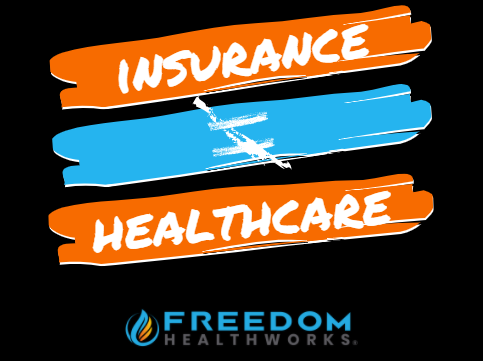
In this election year, we are likely to hear politicians from both major parties blather on about their preferred solution for “healthcare.” I can accept that intelligent people, acting in good faith, can come to very different conclusions about how our system should be run in the United States, but what drives me crazy is how the very parameters of the debate indicate muddled thinking and an inability to clearly articulate the nature of the problem. So let me take a moment to briefly define three different terms that are often used interchangeably, but shouldn’t be, and then talk for a moment about why this matters:
Health insurance is a mechanism by which we pay for healthcare. It is important to understand that it is NOT in and of itself healthcare.
Healthcare is the actual provision of health services to a patient. Healthcare consists of things like doctors, nurses, medications, tests,hospital beds, and surgical equipment.
Health is the absence of disease. A person who possesses good health will need little in the way of healthcare.
It’s crucial to keep the distinction between these three terms in mind as we think about our broken healthcare system. Our politicians talk endlessly about the need to reform “healthcare” or provide “healthcare for all,” or whether “healthcare” should be a right versus a privilege, but what they are really talking about is health insurance, NOT healthcare.
To make an analogy of how healthcare relates to health insurance, consider homeowner’s insurance. If a storm causes major damage to your home, you will probably hire a contractor to make the appropriate repairs, and he or she in turn will hire workers to do the various needed jobs (plumbers, electricians, carpenters), buy the correct supplies (wood, pipes, shingles), get the needed permits from the town, and so forth. You will file a claim with your homeowner’s policy, and they will pay for most of the contractor’s fee, thus saving you from a ruinous bill. But the insurance company itself will not do the work.
In a similar way, a person with a medical issue may be cared for by a doctor or a hospital and may receive a surgery or medication, all of which the health insurance will (hopefully) pay for, but the insurer does not itself provide the required medical care or supplies.
Why does this matter? Because while our leaders have spent the past few decades debating health insurance (how to PAY for healthcare), they have completely neglected the supply of that healthcare as well as the health of the population, both of which, frankly, have gone to hell.
From where I sit, I think we really need to flip our thinking on all of this upside down. Consider the following: Americans, on average, suffer from poor health and a high burden of chronic diseases such as obesity, diabetes, hypertension, heart disease, depression, and cancer. This poor health in turn leads to a very big demand for healthcare. However, due to lots of factors (too many to name here), there isn’t enough healthcare available to meet that demand. This in turn puts upward pressure on costs, which drives the price of health insurance ever higher.
The Democrats and Republicans will each give you their opinion on how to reform “healthcare” (by which, again, they really mean health insurance). And that is certainly a debate worth having. But it’s important to remember that right now, there is a terrible shortage of healthcare, which is in large part due to poor health. If tomorrow we could waive a magic wand and give everyone in the country terrific health insurance that covered 100% of their costs, it still wouldn’t do anything to ensure that you could actually see a doctor in a timely manner or get the treatments that you need, any more than coverage from your homeowner’s policy can guarantee that you can actually find a good contractor to make repairs to your home. And it wouldn’t do a thing to solve the epidemics of obesity, diabetes, drug addiction, and so forth that are plaguing the nation.
Right now, there are millions of Americans who do, fortunately, possess adequate health insurance. But many of them can’t see a doctor when needed, can’t reliably get medications, or wait many months to get a surgery or procedure. And their interactions with the health system do almost nothing to promote better health, focusing instead on fixing (or more often, “managing”) problems rather than preventing problems and keeping them healthy to begin with.
Until our leaders start thinking about all of this in a clearer way, don’t expect the situation to improve much.
This is another reason why I’ve left corporate medicine and gone into Direct Primary Care. By getting out from under the thumb of the insurers, I can focus on a holistic approach to care that prioritizes wellness and prevention, and I can be very available to my patients when they need me.
In other words, for my patients I can solve the lack of healthcare and the lack of good health. All it takes is the willingness to realize that some services are better provided when they aren’t tied to health insurance, and the realization that your health insurance does not, in fact, guarantee you better health or access to needed healthcare.