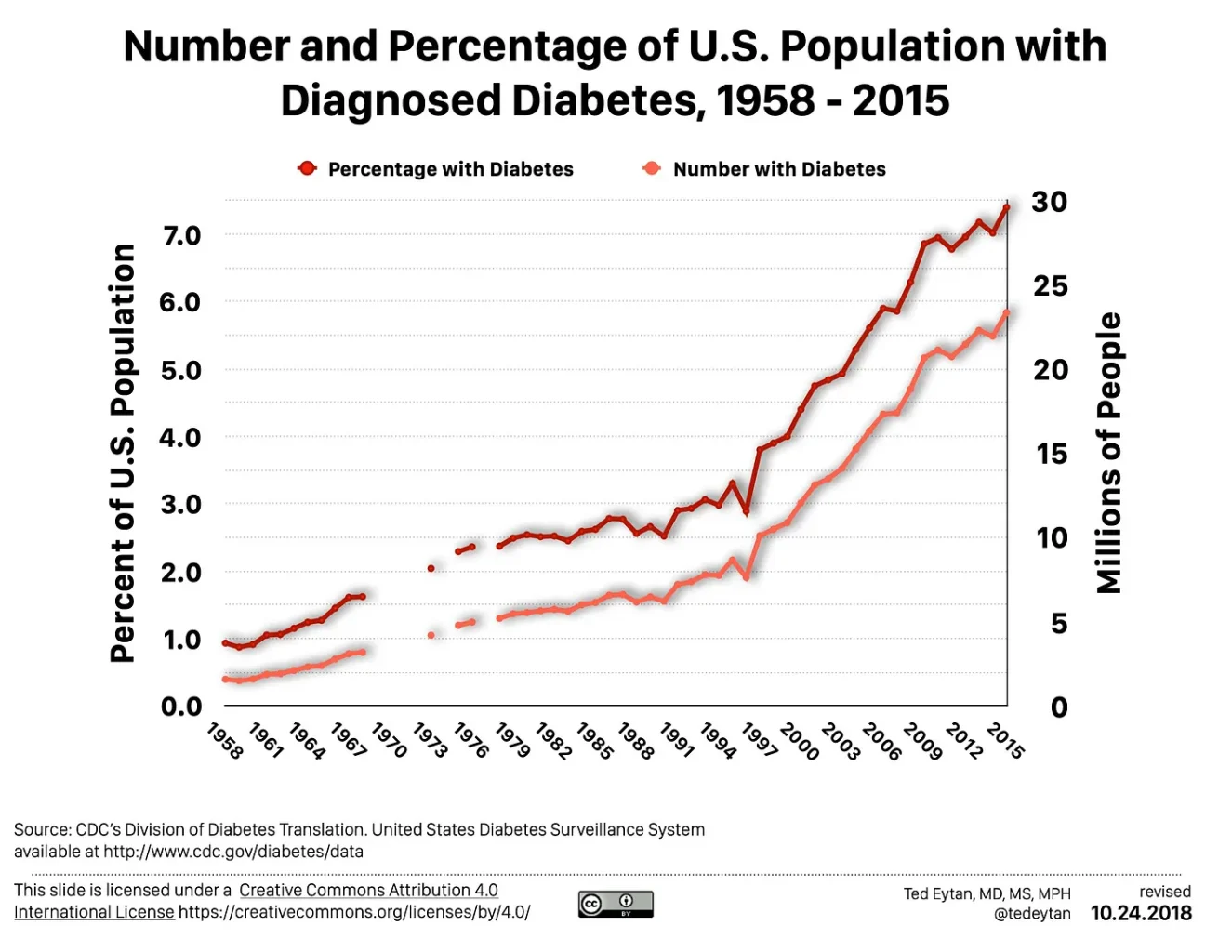
My last post was about the basic biology of insulin resistance and about how it is the underlying root cause of type 2 diabetes, as well as a risk factor in its own right for many diseases.
Today I’m going to answer the question of how to tell if you have insulin resistance.
Tens of millions of Americans suffer from insulin resistance, and most of them don’t even know it. Left unchecked, insulin resistance can lead to heart disease, cancer, dementia, type 2 diabetes, high blood pressure, and lots of other bad health outcomes. But before I can get into explaining how you can know if you have this condition, and what you can do about it if you do, I first need to explain what insulin resistance is.
I was a history major in college, and to this day one of my great interests outside of medicine is learning more about the past. Sometimes I even like to combine these interests by considering whether people of the past have anything to teach us about good health (they certainly have a lot to teach us about bad health in terms of death from things like infection, trauma, and childbirth, but that’s a fairly obvious point that you probably don’t need me to explain in detail).
Thus it was that about a year back, I was watching a documentary about the Roman empire and got to wondering: just how exactly did the Romans prepare their soldiers for combat?
This post is going to be relatively short, and may seem a bit frivolous, but I wanted to write it because it’s about a seemingly small thing that reveals a much deeper truth about DPC (Direct Primary Care) and how it differs from a traditional primary care setup.
Recently I purchased a Nespresso Vertuo machine for the office. I’m a bit of a coffee snob, and let me tell you – this thing makes amazingly delicious espressos.
This post will be extremely short. Back in October of 2023 – when I was still employed at my former practice – I was asked to give a lecture at a conference of physical therapists in Rhode Island. The theme of the conference was lifestyle (nutrition, exercise, sleep, etc.) and how it can positively impact joint health. The focus of my talk was on nutrition, with an emphasis on how proper nutrition can support better joint health and ease chronic pain, as well as on tips for losing weight. If you are interested, the folks who sponsored the conference have now posted a video recording of the talk on YouTube, embedded above.
Special bonus: if you forward to the 24:28 mark and watch just the last seven minutes of the video, you will hear my thoughts on what we can learn from the ancient Romans about how to have better health today – a topic that I will be returning to in another blog post soon.
There are so many problems with our current healthcare system. The difficulty getting appointments. The rushed visits. The paperwork. The surprise bills. I’ve addressed how Direct Primary Care solves a lot of these in my last post. But there’s another element I haven’t touched on yet, but that’s ultimately even more important: insurance driven care is very standardized, which means that it’s often five, ten, or even twenty years behind the science.
To illustrate this point, let me give an example. Let’s suppose that tomorrow a new test was developed that could accurately diagnose pancreatic cancer (one of the most lethal types of cancer) years before it could otherwise be detected by current means. You would think it would be adopted right away by the medical establishment and that doctors would be offering it to every patient at their annual physical starting immediately. But it’s almost certain that would not happen.