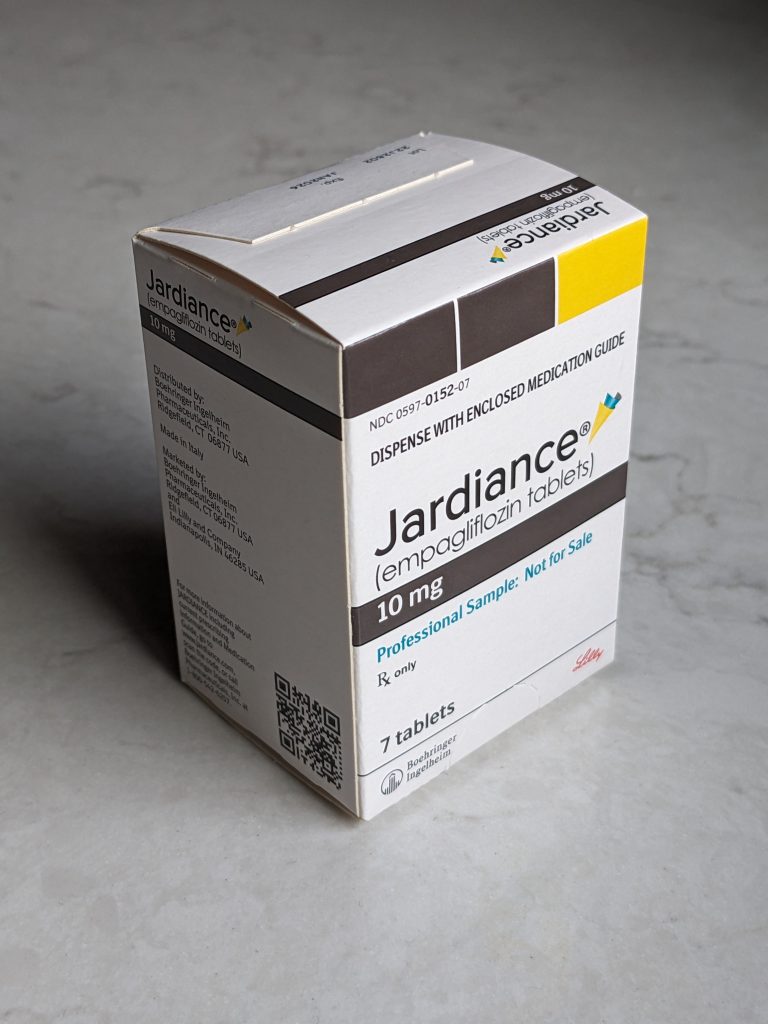
So annoying, in fact, that I googled it, and found out that there’s a whole culture of people out there who find the ad equally repellent. Many, unfortunately, have commented on the size of the main actress, and the backlash against the backlash against the commercial (isn’t everything in America these days a backlash against a backlash?) is that the haters of the commercial are simply “fat shaming” the actress. So let me state right off the bat that indeed, fat shaming is a horrible thing, and my objection to the commercial has nothing to do with the fact that the lead actress is overweight.
Rather, what really irritates me about the commercial (other than the cloyingly obnoxious jingle) is that it perpetuates the great pharmaceutical lie about type 2 diabetes: namely, that it’s an incurable disease that is best controlled with medication. Nothing could be further from the truth. The fact is that type 2 diabetes is often curable, and almost always manageable, with lifestyle modification, and – provided they make the correct changes – many type 2 diabetics don’t require any medication at all.
In recent years, there has been an explosion of interest in healthcare related content on the internet. Podcasts by figures such as Peter Attia, Andrew Huberman, Rhonda Patrick, Ken Berry, and Gabrielle Lyon, to name a few, have become extremely popular. Typically these podcasts take a health issue and dissect it for the average person, often with a bit of a different perspective than is found in mainstream medicine. And while I don’t agree with every single thing that each of the above doctors says or touts, I think that overall these folks do a great service to the American (and global) public by empowering people to learn more about how to take charge of their own health.
I’m excited to announce that on Sunday, June 30, we will be participating in “A Dose of Wellness,” a multi-business open house here in Marion.
On that date, anybody in the community is welcome to drop by our office (no appointment needed) between 8:00 am and 12:00 noon to get a free tour of our office, meet me, and learn more about the practice. And, as an added bonus, anybody who comes in that morning will be given a free body composition scan with my Styku device (see image below for an example scan – for best results, wear tight/form fitting clothes). In addition, any visitors will be entered into a raffle for a complimentary red light treatment session.
V0027010 Ivan Petrovitch Pavlov. Photograph after a photograph taken
Credit: Wellcome Library, London. Wellcome Images
images@wellcome.ac.uk
http://wellcomeimages.org
Ivan Petrovitch Pavlov. Photograph after a photograph taken in 1934.
Published: –
Copyrighted work available under Creative Commons Attribution only licence CC BY 4.0 http://creativecommons.org/licenses/by/4.0/
The man pictured above is Ivan Petrovich Pavlov (1849-1936) and if you are wondering why the photo of a long deceased Russian scientist is adorning this post, read on. I’ll come back to it by the end – I promise.
In my last two posts (click here and here if you haven’t read them yet), I discussed some tips for developing the correct mindset towards sleep and to lessen the anxiety about sleep that is usually at the root of insomnia. If you suffer from chronic poor sleep, it’s really worth re-reading these posts and internalizing them before going further. With that said, today I’m going to change directions and start talking about steps you can take to actually start sleeping better.