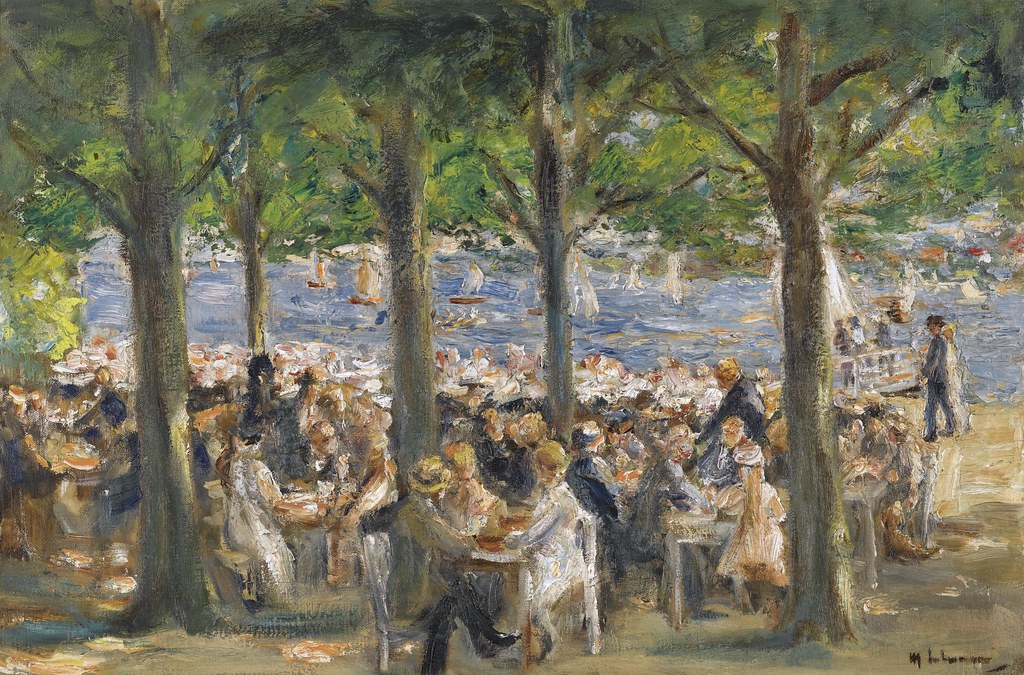
Pictured Above: Max Liebermann – “Beer Garden near the Havel under Trees”, 1920
No, I’m not going insane. I’m just using this week’s blog post to engage in some stream of consciousness. So this post will be long and wandering, but I promise – I do have a point or two to make.
Regardless of where you stand politically, the recent assasination of Charlie Kirk was the latest in a string of public violence which should raise alarm bells about why so many Americans have become socially isolated, mentally ill, and radicalized by the internet into holding profoundly anti-social views. (I’m thinking not only of political assassinations and attacks, such as the slaying of several Democratic lawmakers in Minnesota, the attack on Nancy Pelosi’s husband, or the two failed assassination attempts on Donald Trump last year, but also of the all-too-frequent school shootings and mass terror attacks in this country).
Moreover, the folks who go completely insane and shoot up a school or decide to settle a political grudge with a bullet rather than with debates and votes are just the tip of an iceberg. Sociologists and health researchers have noted with concern in recent years the increasing loneliness and social alienation of millions of Americans. Most of these folks are not about to go out and harm anybody, but they are leading unhappy, sick, and shorter lives as a result of this trend.
Extensive research has confirmed what anybody with a shred of common sense already knows – being lonely is a huge risk factor for all sorts of bad health outcomes, from mental health issues such as depression, to increased risk for heart disease and premature death. If we are going to address issues as diverse as America’s mental health crisis, our addiction crisis, our crisis of chronic disease, our worsening political polarization, and the increasing incidence of headline-making acts of public violence, we are going to have to take on the loneliness crisis that is one of the root causes of so many of these problems.
I was thinking about all of this the other day when my wife (who adores both travel and – in moderation – a good glass of wine) sent me an article from Wine Enthusiast magazine about Portugal’s growing “Wine Kiosk” culture. You can read the full article by clicking here, but to give the TLDR summary:
Back in the 1800s, many cities in Portugal had outdoor kiosks in public squares where people could buy a coffee, wine, beer, or pastry, and sit at an outdoor table, sort of akin to the Italian Piazza or the German beer garden. These kiosks fell out of favor from the 1920s onward, but in recent years there has been a big revival of them and they are now found all throughout Portuguese cities and towns. They have become a flash point for public mingling, a place where friends or family can meet up, or where neighbors and strangers can get to know each other. Now some experts are starting to see these kiosks as creating positive pushback against the alienation and loneliness of modern life, and many are crediting the kiosks for helping Portugal get through the COVID pandemic more smoothly than many of its peer nations. (Though bars and restaurants were closed during parts of the pandemic, the outdoor kiosks remained open as a way for people to safely congregate outdoors).
Summing this all up, many Americans have become lonely, socially isolated, and estranged from family and friends. The consequences of this are many, including poor physical health, poor mental health, substance abuse, shorter life expectancy, and a population that increasingly regards each other with suspicion rather than as fellow citizens with whom to compromise in doing the important work of keeping our country running. One small step to help counter this toxic trend might be to learn something from the Europeans and do a better job of creating communal spaces in which people can congregate to have fun and get to know each other.
And now before completing this post, let me digress to one other point: wine kiosks (obviously) serve wine. No doubt some readers will wonder why it is that a medical doctor is writing admiringly of what are, in effect, outdoor bars.
I’ve touched on this point in another recent post (which I will link to here), but in recent years there has been a growing puritanical streak throughout America regarding alcohol, as scientists have increasingly become more aware of the dangers of alcohol to human health. And indeed that is true. We now appreciate, in ways that prior generations didn’t, that even moderate alcohol consumption can increase certain health risks. I am not, in any way, advocating for increased alcohol consumption.
HOWEVER – human behavioral change rarely occurs in isolation. You would think we would have learned this back in the 1980s when we told people to stop eating fat and they responded by eating lots more sugar and processed carbohydrates, which contributed to the obesity and diabetes epidemics. Had everyone replaced their bacon and steaks with tofu and broccoli, then perhaps there would have been some improvements in the nations’ health, but it shouldn’t have taken a genius to see that people were more likely to replace these items with such monstrosities as fat free cookies and potato chips. The net effect was, on the whole, to worsen the nations’ health.
In a similar way, I am suspicious of the research that suggests even an occasional drink is tantamount to a death sentence. Not because I don’t believe that alcohol is toxic to the human body, but because changes in human behavior almost ALWAYS have knock-on effects. Researchers can account (at least to some extent) for what happens to someone’s risk of coronary disease or breast cancer when they abstain from alcohol, but they really cannot account for something so complex as the psychological landscape that a person – and much less the complex interplay of millions of persons – inhabits and how that might change. Joy and community are good for people’s health, and while it’s probably a sign of a serious problem if you cannot ever experience joy or community while sober, let’s not pretend that an awful lot of joy and community throughout human history have not been intricately linked to alcohol consumption. There’s a reason why alcohol has been consumed since the earliest recorded times of human history, and why even other animal species have been found to seek the stuff out.
To put this plainly: alcohol is bad for people. But so is loneliness and social isolation, which alcohol sometimes plays a role in counteracting. What then is the net effect of creating a society that drinks less? I have no idea, and neither does any other researcher. Remember that the next time you read an article about the supposed dangers of one drink per week.
For my part, I’d like to live in an America where there was a touch more of a sense of community and kinship, where the average person has both the joy and the health protective effects of a network of family and friends, and where people could express their political differences over the proverbial glass of beer without getting violent about it. If an occasional drink plays a role in bringing forth such an America, I’m all for it.