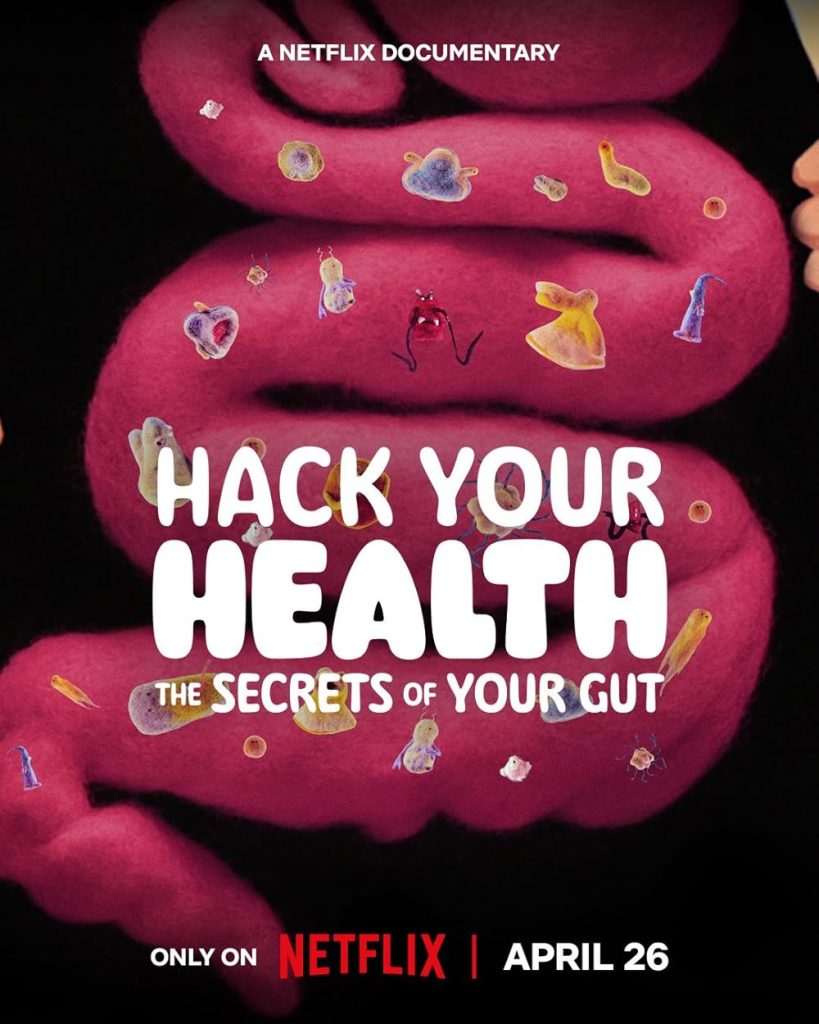
Recently I watched the documentary “Hack Your Health,” which is available for streaming on Netflix. The film covers the emerging science of the gut microbiome (the population of trillions of bacteria, most either harmless or beneficial to human health) that live inside our GI tracts, and that are increasingly being found to play a role in everything from our tendency to gain weight, to our mood, to our risk for various chronic diseases.
I really wanted to like this film, because I think the gut microbiome is a fascinating and important emerging area in medicine, but the film suffered from some major flaws. Overall, I’d give it two out of five stars.
The film bounces around between interviewing different researchers and doctors who are studying the microbiome, and the tales of four individuals – a chef in San Francisco, a psychologist, the most famous competitive eater in Japan, and an entrepreneur in Louisiana – each of whom has a different reason for being concerned about their health and how their microbiome might be affecting it.
On the plus side, the film does a reasonably good job of laying out some of the basic science of the microbiome and explaining how it can affect human health in ways that would previously have seemed unimaginable to us just a few decades ago. For example, they detail one experiment (which I have blogged about previously) which showed that just implanting the bacteria from an overweight person’s colon into a mouse could make that mouse gain weight. They also cover how for one of the subject’s in the film, altering her gut microbiome had a major impact on her mood. I think for the uninitiated, the film provides a good introduction to the topic, and in a reasonably quirky and not difficult to understand manner that lasts only an hour and twenty minutes.
I would also add that some of the main characters are, well, characters. There are some odd people who do some odd things in this film (the film could reasonably be renamed “Poop, and the people who love to think about it.”) Whether you find that interesting or off putting depends on you, but it certainly adds a layer of entertainment to the film.
However, the film left me feeling like it was building up to a punchline that it never got around to telling. For example, we learn of one person who managed to improve his gut microbiome substantially by ingesting smoothies made from sixty different fruits and vegetables. What we never hear about is whether this made this person’s life better in any way. Did they lose weight doing this? Experience improved digestion? Develop clearer skin? Feel more energetic? We are never told.
And each of the four main characters undergo extensive microbiome testing, and meet on camera with a team of doctors to get counseling about their results and how to make appropriate changes. But again, we are never told if this measurably improves any of their lives in any way. Does the entrepreneur struggling with obesity finally lose weight? Does the chef struggling with various food intolerances find relief from her GI distress? The film ends without ever giving us any clue.
Which, now that I think about it, may be a good summation not only of the film, but of what we know about the microbiome in general. Namely that it seems to be important, and that it can be highly influenced by our diet, our stress, our exposure to various toxins in the environment, and so forth. But also that we really don’t yet understand enough about the topic to be able to implement specific recommendations to individual patients in a way that will bring about a particular desired result. It may someday be the case that we will be able to test a patient’s microbiome and, based on the results, tell that patient what specific steps they can take to (for example) lower their blood pressure, much in the same way that we currently have specific medications that can lower blood pressure. But the science just isn’t there yet. And neither is “Hack Your Health.”